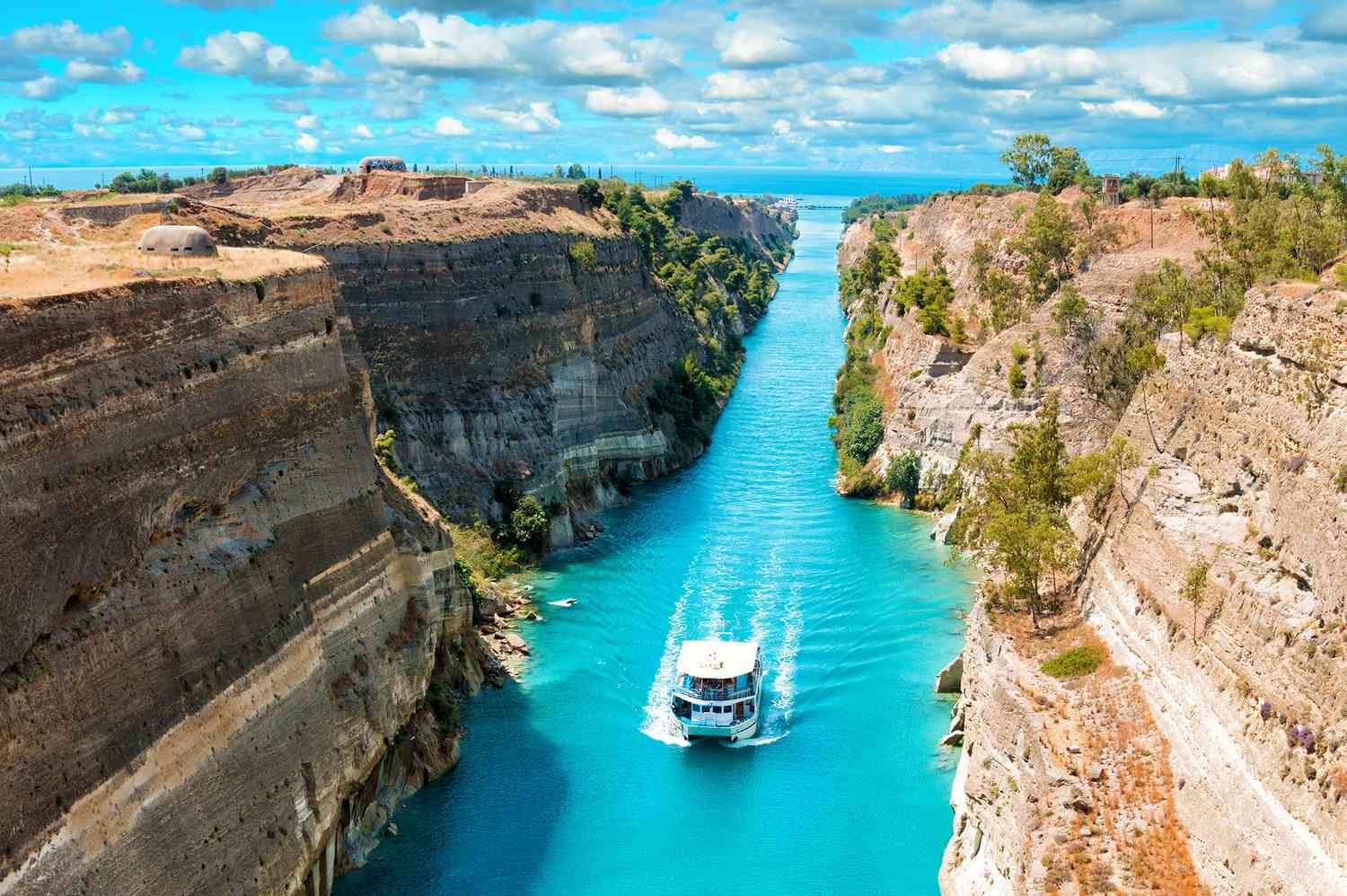
Stand on the bridge over the Corinth Canal and look down. A narrow ribbon of turquoise water runs between sheer limestone walls, perfectly straight for as far as you can see. It’s one of the most photographed sights in Greece, and it’s only an hour’s drive from Athens.
This guide covers everything you need: where to get the best views, how to cruise through the canal, the bridges that sink into the sea, bungee jumping, and how to fit it all into a day trip.
Corinth Canal at a Glance
Length: 6.34 km
Width: 24.6 metres, with a depth of eight metres
Built: between 1881 and 1893
Cost to visit: Free. You can walk onto the bridges and view the canal at no charge.
Time needed: 30 minutes for the viewpoints, 2–3 hours if you add a cruise
Distance from Athens: about 80 km, roughly one hour by car
A Short History: A 2,500-Year-Old Dream
The idea of cutting through the Isthmus of Corinth is ancient. Around 600 BC, the tyrant Periander of Corinth considered it but settled on something simpler: the Diolkos, a paved stone road on which ships were dragged across the isthmus on wheeled platforms. Parts of it still survive near the western end of the canal.
In 67 AD, Emperor Nero launched an actual dig, breaking the first ground himself with a golden shovel. Thousands of workers began cutting, but the project was abandoned after his death.
The dream was finally realised in the 19th century. The principal engineers were István Türr and Béla Gerster, and the canal was first used on 25 July 1893.
It never became the shipping highway its builders hoped for. Its narrow width and shallow depth limit access for modern commercial vessels, and it now mainly serves tourist and smaller craft. That’s good news for visitors: the canal today is less a trade route and more a spectacular landmark.
[INTERNAL LINK: The Diolkos: The Ancient Ship Road Across the Isthmus]
Best Places to View the Corinth Canal
- The Old Road Bridge (Main Viewpoint)
This is where most visitors stop, on the old Athens–Corinth road. Pedestrian walkways let you stand directly above the middle of the canal for the classic straight-down photo. You’ll find a few shops, the bungee jumping facility and a parking area right next to the bridge, plus cafés and souvenir stands.
Tip: The light is best in the morning and late afternoon, when the walls glow golden and the water turns a deeper blue. - The Isthmia Submersible Bridge (East End)
At the Saronic Gulf end of the canal, near the village of Isthmia, there’s a bridge that does something you won’t see often: when a boat needs to pass, it sinks underwater instead of lifting up. Vehicles and pedestrians wait while the roadway drops below the surface, the boat glides over it, and then the bridge rises back out of the sea. - The Poseidonia Submersible Bridge (West End)
The western end, facing the Gulf of Corinth, has a second sinking bridge near Poseidonia. It’s quieter than Isthmia, and it’s the best spot to combine with a look at the remains of the ancient Diolkos.
Tip: Boat traffic isn’t scheduled for the public, so seeing a bridge sink is a matter of luck. If you have time, have a coffee nearby and wait. Boats tend to pass in small groups.
Corinth Canal Cruise: Seeing It From the Water
Looking down from the bridge is impressive. Looking up from a boat, with the rock walls towering on both sides, is something else entirely. A cruise is the best way to understand the true scale of the canal.
Most cruises depart from the port of Isthmia and last around an hour. Among the options, the “Agios Andreas” is a 17-metre vessel with a glass bottom and a capacity for 50 guests, starting from Isthmia port. It is listed on booking platforms from around $46 per person, with pickup available. Larger boats run the same route and can carry bigger groups.
Some operators also offer departures from Loutraki, Corinth, Xylokastro and even Athens, with transfers included.
What to know before you book:
Cruises only run while the canal is open to navigation. After repeated closures in recent years, always confirm before your trip.
Be patient. One recent visitor noted that the wait can be long, because the boat has to wait for all the boats coming from the opposite direction to pass.
Bring a hat and sunscreen in summer; the deck can get very hot.
[INTERNAL LINK: Corinth Canal Cruise: Is It Worth It?]
Bungee Jumping Over the Corinth Canal
If looking down isn’t enough, you can jump. Zulu Bungy was founded in 2003 at the Corinth Canal and operates from the main road bridge, making this one of the most dramatic bungee jumps in Europe.
Opening hours are listed as Tuesday to Sunday, 10:00–17:45, but check ahead, especially outside summer.
Jumps are listed from €120. Prices change, so confirm with the operator.
Booking in advance is wise in peak season, and photo and video packages are sold separately.
Even if you don’t jump, watching others take the plunge from the bridge walkway is half the fun.
How to Get to the Corinth Canal
From Athens by Car
Take the Athens–Corinth motorway (A8) west. The drive takes about an hour. To reach the main viewpoint, exit toward the old national road and the canal bridge, where there’s parking next to the shops.
From Athens by Bus
KTEL Korinthias buses run regularly from Athens toward Corinth and Loutraki and stop at the Isthmus, right by the canal. It’s the easiest option without a car.
From Athens by Train
The Proastiakos suburban railway connects Athens (including the airport) with Corinth station. From there, take a short taxi ride to the canal.
On an Organised Tour
Many day trips from Athens include a stop at the canal combined with Ancient Corinth, or with Mycenae and Nafplio. It’s a good option if you want to see several sites in one day without driving.
[INTERNAL LINK: How to Get from Athens to Corinth]
Combine Your Visit: What’s Nearby
The canal is a quick stop, so pair it with other sights:
Ancient Corinth (20 min): the Temple of Apollo, the Roman forum and the place where St. Paul preached.
Acrocorinth (25 min): a vast hilltop fortress with some of the best views in the Peloponnese.
Loutraki (10 min): a seaside spa town with a long beachfront and thermal springs.
Heraion of Perachora (30 min): an ancient sanctuary beside a lighthouse, with swimming spots and a lagoon.
Ancient Isthmia (5 min): home of the ancient Isthmian Games, with a small museum.
Suggested Half-Day Plan
Morning: Corinth Canal viewpoint, plus a cruise from Isthmia if it’s running
Midday: Lunch in Loutraki or by the sea at Isthmia
Afternoon: Ancient Corinth, then sunset at Acrocorinth
[INTERNAL LINK: Athens to Corinth Day Trip: The Perfect Itinerary]
Where to Stay Near the Corinth Canal
Most visitors see the canal on a day trip, but staying nearby makes it easy to explore the rest of Corinthia. Loutraki has the widest choice of hotels and a lively seafront; Corinth is practical for Ancient Corinth and Nemea; and the coast toward Xylokastro is quieter and ideal for beach days.
[AFFILIATE BOX: Hotels near the Corinth Canal (Booking.com)]
Frequently Asked Questions for Corinth Canal
Is the Corinth Canal open in 2026?
Yes. It reopened in June 2026 after being closed since mid-November 2025. The canal has a history of temporary closures after landslides, so check the latest status if you plan a cruise.
Is it free to visit the Corinth Canal?
Yes. Viewing the canal from the bridges is free. You only pay for a cruise, bungee jumping or parking at some spots.
How long do you need at the Corinth Canal?
Around 30 minutes is enough for photos from the bridges. Allow 2–3 hours if you add a cruise or want to watch a submersible bridge in action.
How deep and how wide is the Corinth Canal?
It is 24.6 metres wide and eight metres deep. The walls rise dramatically above the water; cruise operators describe cliffs reaching up to 80 metres high.
Can cruise ships go through the Corinth Canal?
Only small ones. Large modern cruise ships are too wide, which is why the canal is mostly used by yachts, sailing boats and small tourist vessels.
Is the Corinth Canal worth visiting?
Absolutely, especially since it’s right on the way from Athens to the Peloponnese. It takes little time, costs nothing to see, and delivers one of the most striking views in Greece.